
Key Takeaways
- There are five essential components of the best home theater setup, each contributing to the room's overall performance.
- You need a display that accounts for the viewing distance and room conditions.
- Speakers are also important, and they should follow the seating arrangement for balanced sound throughout the room.
- You need an AV receiver that supports your media sources, speaker configuration, and display capabilities.
- Acoustic treatment and lighting control are also needed to reduce unwanted sound and light reflections.
- Finally, a centralized control system will help you manage compatible home theater devices from a single interface.
Most people trying to figure out how to build a home theater room probably have an idea of exactly what they want and what they would use it for the most. Movie lovers might therefore prioritize different things from sports fans, for example.
This is why the best home theater setup is one that your household will genuinely enjoy using. But before diving into the unique preferences of each user, there are some essential things that every home AV setup needs.
These are the things we’ll discuss in this article while helping you understand what to prioritize in your own setup so you can approach the project with clearer expectations.
Essential Components of the Best Home Theater Setup
Here are five components that form a well-designed media room. Remember, decisions about one piece often influence the others.
Home Theater Display
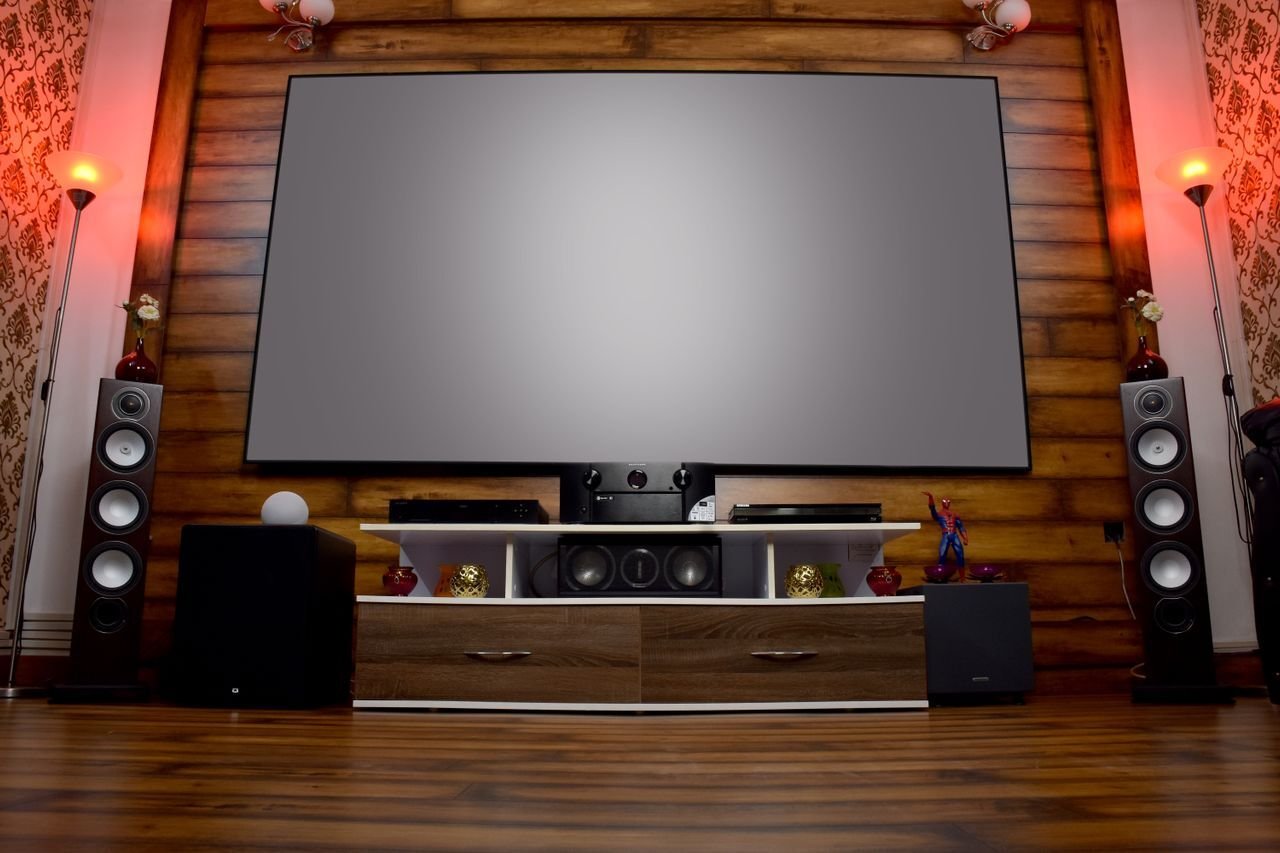
If large and detailed images are non-negotiable for you, this will determine the display that makes it into your home theater setup. The best option might be a 4K laser projector paired with a large projection screen to create a cinema-like experience, particularly in a dedicated theater with controlled lighting. Alternatively, an OLED TV has excellent contrast and deep blacks, making it a great option for multipurpose media rooms.
As you build a home theater room, try to think about how far you want the viewing distance to be. This will help you determine the appropriate screen size.
For projector-based installations, an acoustically transparent screen makes it possible for speakers to be placed behind the image without obstructing the sound.
Audio System and Placement
The best home theater setups always have great audio. This is not to be mistaken for having great speakers. In home AV setups, even expensive speakers can be disappointing if the system isn’t properly suited to the room.
Begin with how and where people will sit. The front left and right speakers need enough separation to produce a broad soundstage, while the center channel should face the listeners for clear dialogue.
The same attention should go into positioning the surround speakers. These are generally positioned beside or behind the seating area, but if one is too close to the listener, its sound effects may dominate the soundtrack rather than blend naturally with other channels.
The best home theater setups also pay attention to how low-frequency bass behaves throughout the room. This helps avoid issues like a subwoofer that produces powerful bass in one seat but not another. Test different locations before completing installation and calibration, so you achieve consistent sound across the seating area.
AV Receivers, Media Sources, and Connectivity
An AV receiver is what you’ll need to manage how audio and video travel between the different devices in your home theater. The best option for your setup is going to be the one that supports the formats your devices use, with enough connections to accommodate everything without constantly swapping cables.
As you build a home theater room, try to think about how you’ll access your entertainment because streaming devices, gaming consoles, Blu-ray players, and other components of a home AV setup have different connection requirements.
The receiver also decodes the audio from your chosen source so that each speaker reproduces the appropriate channel. Its built-in amplifiers provide the power needed by passive speakers. Meanwhile, the video signal is passed through to your display.
This means that for the best home theater setup result, your receiver must support the number of speaker channels you intend to use and the video formats your display can handle. Otherwise, it could limit the performance of equipment you’ve already invested in.
Room Acoustics and Lighting
Once you’ve got all the AV equipment set up correctly, you don’t want unnecessary sound and light reflections. This is where room acoustics and lighting come in. You want to limit hard surfaces like hard floors and bare walls because these reflect sound, creating unwanted echoes that interfere with what you’re hearing.
The best option for your home theater setup is to install sound-absorbing wall panels that can reduce these reflections, as well as carpeting to limit sound bouncing off the floors. The amount of treatment should depend on the room’s acoustic characteristics.
Lighting is also an important part of how to build a home theater room. Consider using motorized blackout shades to prevent daylight and other external light sources from washing out the picture. While inside, you could also use dimmable wall sconces or recessed lighting to provide enough illumination to move around comfortably without distracting from the screen.
Centralized Home Theater Control
With all these devices making up your home AV theater setup, having to operate each one of them separately can be a frustrating headache. That’s why the best home theater setups also need a centralized control system.
Instead of switching between remotes and applications, an integrated control system allows you to manage compatible equipment from a single interface.
You could consider a platform like Crestron Home, which supports programmed scenes that can activate your entertainment system and adjust the room’s lighting automatically.
However, before choosing a control system, check its compatibility with your planned AV equipment. This will save you from purchasing devices that cannot be integrated into the same control platform.
Build The Best Home Theater Setup with Profound Technologies
While this information is highly useful, bringing it all together into a practical result can be a bit intimidating, especially if you want to get it right the first time. Fortunately, this is what we do at Profound Technologies.
With over 20 years of AV industry experience, Profound Technologies has designed and installed custom residential AV systems for luxury homes, besides our other services.
With our experienced team, you don’t have to worry about how to build a home theater room on your own. We can help you plan the best home theater setup for your space, with equipment selected to work together from the outset. Schedule a free consultation with our AV experts.
Frequently Asked Questions
Can you convert an existing room into a home theater?
Yes, as long as the room’s dimensions can accommodate your intended layout, of course. You’ll also need to assess the existing electrical outlets and the cost of any new installations.
How much does a great home AV theater setup cost?
There’s no fixed price because the cost depends on your equipment choices and how much construction work the room requires. Luckily, you can contact us at Profound Technologies for a free consultation.